Showing posts with label North Cost Business Journal. Show all posts

Wednesday, January 18, 2017

Credit Card Skimmers and Your Security

Recently an article was published in the News Messenger titled “Credit card skimmer found at a gas station in Bellevue” highlighting a recent sweep for these devices covering 60 of the 88 counties in Ohio. So what are credit card skimmers? Skimming is an electronic method of capturing a victim's personal information used by identity thieves. The skimmer is a small device that scans a credit card and stores the information contained in the magnetic strip. Many times this device is placed over top or within the original credit card processing machine and can be difficult to detect at first glance.

Skimmers can be placed pretty much everywhere that credit card transactions take place. Gas pumps, ATMs, and lottery machines all being good examples. They can be bought up front for several hundred dollars online, and then have the added cost of the electronic components used to store or transmit the stolen credit card data. Data can be stored locally to the skimmer or some newer models have been known to transmit the data over Bluetooth. Criminals will also add or have built-in pinhole cameras or add another PIN pad over the original to capture the PIN being used.

So what can you do to protect yourself against these types of devices?
Be vigilant and aware of the devices you are putting your credit cards through. 

  • Try not to use ATMs that are not located in publicly visible and well-lit areas.
  • Whenever you enter your debit card's PIN, Just assume there is someone looking. Maybe it's over your shoulder or through a hidden camera. Cover the keypad with your hand when you enter your PIN.
  • Stop and consider the safety of the ATM before you use it. The ATM inside a grocery store or restaurant is generally safer than the one that is outside on the sidewalk. 
Check for tampering.
  • Look for odd protrusion or off-color components on a card reader.
  • Check for some obvious signs of tampering at the top, near the speakers, the side of the screen, the card reader itself, and the keyboard.
  • If something looks different, such as a different color or material, graphics that aren't aligned correctly, or anything else that doesn't look right, don't use it.
  • If you're at the bank, it's a good idea to quickly take a look at the ATM next to yours and compare them both. If there are any obvious differences, don't use either one, and report the suspicious tampering to your bank.
  • Even if you can't see any visual differences, push at everything. ATMs are solidly constructed and generally don't have any jiggling or loose parts. 
  • Most skimmers are glued on top of the existing reader, they will obscure the flashing indicator.

Work with your bank.


  • If you haven’t already, you should switch to a chip-enabled credit or debit card. New MasterCard and Visa rules that went into effect Oct. 1, 2015, put merchants on the hook to absorb all costs of fraud associated with transactions in which the customer presented a chip-based card yet was able to take advantage of it. The chip cards encrypt the cardholder data and are far more expensive and difficult for card thieves to clone.
  • Timely reporting is very important in cases of fraud, so be sure to keep an eye on your debit and credit card transactions. Personal finance apps like Mint.com can help ease the task of sorting through all your transactions. 
  • Try to use a credit card whenever possible. A debit transaction is an immediate cash transfer and requires making a FDIC claim which can take weeks to be processed.
  • Pay attention to your phone. Banks and credit card companies generally have very active fraud detection policies and will immediately reach out to you, usually by phone or SMS, if they notice something suspicious. Responding quickly can mean stopping attacks before they can affect you, so keep your phone handy.


For additional information as well as more in-depth guides for detecting skimmers you can visit this collection of blog posts http://krebsonsecurity.com/all-about-skimmers/

Wednesday, July 20, 2016

Security for the Masses

Not long ago I was talking to my mom a little about what I do. I explained to her the intricacies of implementing solutions, securing large organizations, and some of the overall struggles we face day to day. After this conversation she came to me and said that I should write something about how the average person should be mindful and protect themselves day to day on the internet and on their computers. While this won’t be super technical content, I do hope that it will be an article you can share with your family members, friends, and coworkers on how to better keep themselves protected.
This is going to be a sort of laundry list of ways that the average computer user can better secure their life day to day. Being in the information security industry, I see super scary hacks and ways that bad attackers can take advantage of everyone. While I won’t go into what all of the scary things are, I’ll list the top 5 categories that will give the biggest bang for your buck.

Password Security

    Password security can be difficult depending on how you handle it. You have a hundred things that you need to use passwords for, there is no way that you’ll be able to remember them all, right? Wrong! That’s something that we all have to deal with in this day and age. There is a type of software called a password manager that you can install. This software will allow you to have a strong, unique password for each website or service that you use, without you having to remember it. It is securely stored in the application, and the only password you will need to remember, is for the application itself. A few reputable password managers include, KeePass, LastPass, PasswordSafe, and 1Password.
    You also should remember not to trust others with your password. Not only people, but never ever save your passwords in your internet browser. It is very easy for malware or viruses to steal that information.
    Since you’ll be using a password manager now, make sure your passwords are strong. An 8 character password will take anywhere from 30 seconds to 24 hours to crack with a free piece of software from the internet. At least for your important accounts (banking, amazon, ebay, paypal, anything connected to something money related) you should use a 10 character passphrase. Doing this correctly will make your password almost impossible to crack. One way of making secure passwords easier to remember is using phrases from books, songs, expressions, etc, and substituting characters. The phrase

    “You Are My Sunshine” == You@reMySunsh!n3. 

    This passphrase would take over several hundred years to crack because it contains a 10 character string with upper & lower case letters, a number, and a symbol. Here are the top passwords from 2015 that you should never use:


Enable Multi-Factor Authentication/MFA (or Two-Factor Authentication/2FA) on sensitive accounts

    2FA takes your login and password for a website or service and gives you a very high increase in protection. Many banks provide it as an option, as well as Facebook, Twitter, other popular social media accounts, Gmail, etc. 2FA adds another step in the form of a PIN or code to your login process by either texting it to your cell phone, emailing it, using an application such as Google Authenticator or Duo Security, or a physical device such as a key fob or token generator.
    On the website https://twofactorauth.org/ you can search for services and it will list who does and doesn’t offer it as a service. More than likely you will be able to find your 2FA setup in your account security properties on each individual site.


Learn to be suspicious

    You should be suspicious of any email, link, popup, or phone call that tries to create a sense of urgency. There are scammers out there everywhere. Many times they try to specifically target residents of retirement villages, but most will try their tactics on anyone. They come in many forms and here are a few:
  • A fake email (called phishing) that may look exactly like a service that you use. These emails are very easily created and are attempting to direct you to a malicious website or infect your computer. If you have concerns from an email, never click on a link directly in it. Instead open up the website in a browser and type in the address manually. If there is any problem with your account you can either find it there, or call the company directly.
  • A pop-up telling you that you have a virus or system slowness, and clicking *here* will fix everything. Do not click on it! It’s a malicious ad or pop-up on a potentially infected website that is trying to spread the infection or steal your information.
  • A phone call from “Microsoft”, ”Dell”, or another well known company asking for access to your computer. No one, ever, at any point in time, will call you at home to request access to your computer or information from you. If at any point in time you believe that it is a legitimate request, get their name and call back number. Don’t actually call them back at that number, but look up the service that you use, whether it be financial, medical, or otherwise and call that number instead to inquire about your possible account issues.

Perform Routine Maintenance

    Perform routine maintenance, such as updating your anti-virus (don’t let the renewal pass), and running anti-malware software monthly. There are several anti-spyware and anti-malware companies that are reputable. Download the software directly from their website and not from an ad elsewhere. www.Malwarebytes.org is a great piece of software that will find and remove security risks from your computer. Update and run Malwarebytes once a month, and remove everything it finds. There is a free and paid version.
    More than likely you are running a Microsoft Operating system of some type. You should always apply updates monthly. There are going to be many other pieces of software on your computer that you should keep up to date as well. Things like Adobe Reader, Firefox, Chrome, etc that will have constant security bugs that need fixed. A free piece of software called Secunia (www.secunia.com) will let you know what pieces of software are vulnerable to an attacker. Also, please, if you’re reading this and have Windows XP you need to do everything in your power to get onto a newer operating system. Just trust me.

Protect your browsing

There are a large amount of websites out on the internet that are infected, compromised, or  just plain bad news. Here are a few things you can do to mitigate this:

  • Use a web browser other than Internet Explorer (IE). www.google.com/chrome or www.getfirefox.com are both exceptional browsers that have the ability to be more secure than the default IE.
  • Install extensions on your new browser. Two extensions specifically, one named Ad-blockerPlus and another called No-Script, will turn off a large portion of very bad things displayed on websites.


I hope that all of the above tips can be something that you would handout to the circle of people that you know. Security is everyone’s responsibility and the more we all work towards a common goal, the safer we all become!

Wednesday, May 25, 2016

Getting your foot into the infosec door

Time and time again I have the discussion with my peers about mentoring and a starting a career in infosec. I’ve been asked my opinion, what I’ve personally done, and what others can do to be successful. Recently there was a panel discussion held on the subject of infosec careers at a Michigan Security group called #MiSec. It covered a large range of information such as mentoring, networking, contributing, and attitude. For a good write up on the session itself you can visit  https://blog.greenjam94.me/path-dark-side/.

It is said that the lazier the tech worker, the harder they work to automate tasks. My goal is to put down my thoughts in this article to point others to for a beginner guide of my recommendations. While it’s only driven by my personal experience and observations, it seems valuable to enough people to warrant it’s own automation.
So a fast primer on how I got here. Like most people I wasn’t born into information security. I’m what you would consider a late bloomer to technology compared to most. I had plans on joining the Marines and when that didn’t pan out for personal reasons I thought to myself “Hey I’m decent with computers, I’ll do that!”. I didn’t have my first tech job until I was almost out of college. I had gone for my 2 year “Helpdesk” degree at a local tech college and honestly had no idea what I had just learned or how to apply any of it to the real world. After 5 years at various helpdesks and another 5 as a network/systems admin I was finally introduced into the world of infosec. I had no idea that it was an entire subculture.

My first toe step into infosec had come from a project that a friend had gotten me involved in. Being an overachiever, I had jumped in right away and started to work on this project. Bi-monthly skype meetings, shared documents, collaborating with people I barely knew. I was loving it! Shortly after that the project owner killed it but I had already started the ball rolling in my mind. I knew that I wanted to be a part of more than just a 8-5 job. I cared immensely for the work I was doing day to day and I wanted to continue and expand upon that to help out as many people as I could. Even being involved in a project that didn’t go anywhere gave me the drive and experience I needed to realize that there was so much more out there that I could be involved in. So that is my first piece of advice. Find or create a project. It doesn’t matter what your skillset is, there *will* be a project out there that needs help. Documentation is needed on 99% or more of the open source projects out there. If you’re good at scripting or programming find a need and fill it. It may help you in your day to day job, or maybe it’s just a fun project that you do on the side. Either way you are spending your time on something useful that could end up helping save time for someone.

My second piece of advice is volunteer and participate at an information security conference and attend local meetups. There are hundreds of them across the US and they almost always need volunteers. Just attending a conference has it’s benefits, but truly immersing yourself will push you further to learn and experience more. Maybe you saw someone give a talk or training on something or overheard an interesting conversation. Many careers have been started by having a simple conversation about a passion over lunch or a beer. Remember those projects that I talked about working on before…...a great ice breaker. Networking is a game changer in our industry. I’m not saying that it’s the silver bullet for everyone. You can network all you want, but unless you are a desirable candidate it won’t matter. Having a willingness and desire to learn, listen, collaborate, and the ability to think for yourself are all ideal traits in such a fast paced industry. Others will want to work with you if you are a positive person that they can rely on and trust. You can also join a team for a capture the flag (CTF) or other competition, attend training, or maybe even create your own event. CTFs are a great way to challenge yourself and build problem solving skills. You can learn by watching and competing with others.

Another item to add to your “to-do” list should be to either find or be a mentor. Mentorship can come in many forms but is not just going to be solutions and information handed to you on a silver platter. If someone is offering to mentor you, they are doing it for free with their extra time, so don’t screw it up. Remember, they don’t owe you anything. Mentoring can be extremely rewarding for both parties and also can occupy a lot of time depending on the level of commitment. Try to find someone in a different company so you can bounce ideas off of each other from different perspectives. You don’t have to have a strict career path to be mentored. With so much information in infosec having a broad understanding of any piece of it will help you down the road.

While a career in information security could be an 8-5 job, to excel in it won’t be. I think it’s safe to say any career can be made into an 8-5 without personal and professional drive and commitment. You are going to get a return on investment only on the work that you put into it.

Monday, December 28, 2015

RUCTFE and why a CTF can benefit your organizational security.

I had the great honor of being the defensive (blue) team captain for the RUCTF, a technical capture the flag event organized by a group of security professionals located in Russia. I enjoy being able to lead and teach others, learn new tactics, and be a part of a competitive team. Misec (www.michsec.org) is a collection of Michigan (and in my case, Northern Ohio) based security professionals that meet regularly to learn, compete, and socialize in different ways. In this article I have a co-author that has written about his first CTF experience. James Green is a senior at Michigan State University in East Lansing, Michigan. After you read about his experience I’ll go over why challenges of this nature can benefit your organization.


My First CTF: RUCTFE 2015 with #MISEC


What is ruCTFe?

First off, it is a capture the flag! Why am I so pumped about a game of capture the flag? It is the international hacker version of capture the flag!! Imagine this, Russia is the host and they give every team a virtual machine (vm) with a number of applications “ready” to be deployed. Each team is responsible for keeping their applications online as well trying to bring down other teams. Our Russian hosts have access to everyone’s vm and are able to “drop” flags throughout them.  Flags are strings like “A23HFK36JG732IE436GHD8OVH1297QUF=” and you know it’s a flag because it’s 32 capital letters and numbers followed by a “=”. Each app has a unique twist that makes the game more interesting. For example, one was written in Python, another was in C and used .cgi files. Some stored data in mysql and sqllite databases, others used files with JSON. The variety added complexity that made the game more fun. Misec arranged people into four groups. Red team focused on attacking other teams and searching for flags. Blue team was responsible for defending our applications and hardening the security of the server. Green team was operations, they built and maintained the network. Fuchsia team were our developers  and became jack of all trades because they worked alongside red team on code dives while implementing blue team’s defenses.
I was a part of the red team. I really enjoy penetration testing and I knew this would be great experience. Our team lead was Austen, and he walked me through a lot of what it means to be on the read team. I’m very thankful for his help. Last weekend was a prep meeting and I found out that my old Kali box wouldn’t update, so I had to prepare a new one during the week. #Misec was really helpful every time that I got stuck or hard a question during setup.

Walk Through


My day started at 3:30am with a blaring alarm clock. That was probably the worst part of the day, which also means the day would only get better right? I arrived on site around 4:20, just in time to help hang wires and bring in equipment.  As everyone showed up, we brought out our machines, connected everything and got the VMs ready. I worked with Brad (Fuchsia lead) and Austen to reset the root password and config SSH so that I could log in from Kali. Once our environments were set up, the red team started looking for what ports were open and what  services were listening. This was the first time we found what the apps were using. Like I said earlier in the explanation, there was a wide range of databases and languages at our disposal. Brad dumped the databases and passed it around for others to try and understand while Amanda (Blue lead) searched for passwords and configurations that needed to be updated. Otherwise other teams could use the default accounts to hack into our VM.

Throughout the morning, the green team worked to get the network online. As they did that, the red and fuchsia  teams searched high and low for vulnerabilities in our VMs that would get us an advantage against other teams. The blue team continued to check and secure them as needed. I spent this time running my VM through Armitage. I wasn’t able to find any exploits right away that the apps were vulnerable to, but that was to be expected. Armitage is very automated and it’s hard to customize exploits to work with specific apps. After that turned out to be unsuccessful I turned my attention towards Burp Suite. However, I wasn’t able to configure it correctly so I turned my attention towards code dives hoping to find something obvious like SQL injection or worse. The apps were all in their own directories under home/ and it was very interesting to look through how our hosts had made the VM. As I was looking around, Austen found one of the apps used the same auth token in a cookie for every user in the app. I helped him confirm that by recreating what he did on my VM. The idea for a exploit was that if we could pick up  a player’s cookies when they dropped flags off to the host, we could get into the apps they were just at.  Austen also found a second vulnerability where for the Python app, the password was “hashed” by turning numbers into their ascii hex equivalent. I wrote a small python script to decode the hashes incase we ever got a hold of another team’s JSON files. Just a quick note, this is the first script I’ve written to help break a web app and I was really excited to see how easy it seemed; the development background (and wide range of python libraries) really helped.

The apps go live


Between 11 and noon, the green team was able to bring our network online at full capacity. This was our first time being able to score points and everyone was really excited. However this also brought a new issue, where other teams could now attack us. The plan seems to be working pretty well though, we were earning points for keeping the app alive and no one seemed to be trying to attack the server too badly from the outside. As soon as the red team had access to other teams, we started to poke other teams servers to see what was possible. I tried to find a way to get my python script to work, but first I needed a way to find the json file. I tried calling it directly from the URL, SSH-ing into their application server, and just crawling through the app. This didn’t turn out very well so I tried another tactic. Now that we had real targets, maybe it’d be worth trying Armitage again, other applications might not be as hardened as ours, right? Well, like my VM, it didn’t return any easy results, so I abandoned the idea to return to poking at random teams’ apps, hoping to find a XSS or SQL injection bug somewhere. While I was digging around, my box froze. I just rebooted Kali and continued my barrage of random attempts to attack other teams.

During my assault, Amanda came over to ask if we had done a game-wide nmap scan to list all of the active teams. The game was a almost 3/4 of the way done and no one on the red team had thought to scan everyone after we had gotten our apps up on the game network. Amanda showed me how to use RAWR, a python wrapper of nmap that allowed us to scan and log more cleanly than just saving nmap output straight to a text file. While Amanda filled me in, she was scanning some of the other teams’ servers. I used Python to create a input file for RAWR that would hit the production box for 254 ip addresses. As I started to run the scanner, Austen found another way to grab flags by recreating auth tokens for users of a Ruby app. He quickly wrote up a Ruby script to loop through different teams and a range of IDs both of which were used to create the auth tokens and distributed the code amongst the red team to try and crack as many teams as possible. He ran the code first and started to find flags on the other teams servers, however when he went to turn them in, the host’s scoreboard server was having connection issues.

Down to the wire


Since there were issues from the host, we tried to hold onto flags until we were able to reconnect to the scoreboard and turn them in.  This was risky because it was going on 2pm and the game was only live for another hour. As soon as Austen found a valid flag, the red team started running his script over different teams trying to get their apps to give up more flags. I made a couple modifications to his script on my box so that instead of going through 100 IDs on a team, then going to another team and so on, the script would ask me for what team to scan and wouldn’t iterate to a second team. I was able to use this modification to run a few scripts at once and try to grab as many flags as possible. As we were searching, we were able to find a good amount of flags. The second modification I was trying was to add inputs for the starting and ending IDs for the script. I couldn’t get it to work and didn’t know why until after the game ended when I asked Austen to look it over. I was still able to get 6 flags in the last ten minutes of the game and I was very excited to have contributed to increasing the team’s score. It felt amazing. At the end of the game, we were ranked 118th out of over 300 teams and I was proud to have helped and learned so much, especially since we climbed 3 ranks within the last few minutes!
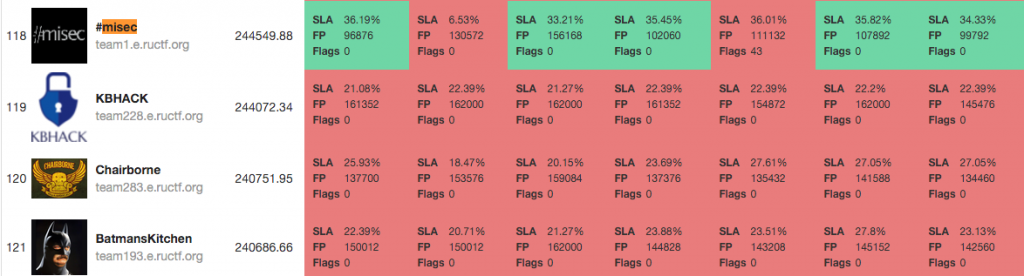

ruCTFe partial scoreboard

Misec beat Batman

Conclusion


I want to give a huge shout out to Misec for pooling some great local talent into an awesome team. Thanks to Steven for organizing this year’s event and to Jason for building our infrastructure/network. Also, if it wasn’t for Austen, Brad, Amanda, Wolf, Ben and everyone else who helped me and made me feel like a member of the team. I wouldn’t have been able to learn as much as I did or have as much fun without you. I can’t wait to see what will happen at ruCTFe 2016!

- James Green


As you can see, for the junior members of your organization or team members that want to learn new or improve upon existing skills, participating in CTF type challenges is invaluable experience. They are well crafted scenarios that can put you and your team in real life situations. Somewhere that you are able to practice both defensive and offensive skills and learn from a variety of people in different information security roles. Many companies don’t have the time or resources to create such elaborate scenarios for the practice that is needed for responding and handling real threats. The communication and technical skills gained from this practice will give you the upper hand no matter what role you play.

There are a variety of types of CTFs from jeopardy style where you submit certain answers (flags) for points, or in the case of RUCTFE it was an attack/defense design. If you are interested in participating you can contact a local security group or visit https://ctftime.org/ for a listing of some of the current ones that are out there. Whether you show up to organize, teach, learn, or spectate I can guarantee that you’ll leave having learned something new.

Tuesday, September 22, 2015

Two-Factor Authentication: It’s not your mamma’s internet anymore.

The other day a friend of mine decided that it should be International Password Awareness Day.

“I am declaring today as International Password Awareness Day. After being in InfoSec for almost 20 years I have found that the single worst problem we have created is poor password hygiene. Not only do we make terrible passwords, we allow others to make even worse ones without holding them accountable. So let's all take a moment today to fix that. Change your password , ask your family, friends and coworkers to change theirs.” - Chris Nickerson

This is an amazing idea!! It should be the start of a movement for better passwords everywhere! Sometimes however, I get ahead of myself and have to take a moment to step back. I then realize that for the most part password strength still won’t matter. Don’t get me wrong, with the passwords that we’ve seen in recent breaches or professional engagements, 99% of you need to go change your passwords right now (to a good one).

Even as much as I am into information security, I still have some bad habits when it comes to my personal passwords. I keep most of them in an encrypted password safe program, I don’t use dictionary words, keep them complex, don’t reuse them, and keep them over 12 characters. One of the practices that I don’t keep up with (as much as I should) is changing my passwords at a regular interval. Honestly it’s a huge pain. Sure if there is a big breach I’ll go and change my important account passwords. What ends up putting my mind somewhat at ease for a majority of my accounts is using services that allow you to take advantage of Two-Factor Authentication as a method to strengthen the login process.

Two-Factor Authentication (2FA) is a method of identifying individuals by using two separate methods. While the number of services and websites that provide 2FA is increasing, we rarely think about it in our own enterprise environments. There are a surprising amount of companies and services that decided to implement 2FA after a large scale or high visibility breach. Shown below is the widely known AP Twitter hack that brought the stock market down in April of 2013.


Amazingly Twitter started offering 2FA in August of that same year, less than four months later. While you can argue that this specific hack may still have been possible as it was proven to be a phishing attack, it’s also likely that 2FA could have prevented it as well.


Why Two-Factor Auth?

2FA is not a new concept. It was patented in 1984 by Kenneth P. Weiss and has been slowly gainging popularity throughout the years. One of the first widley adopted methods of 2FA were the card and PIN at ATMs. Now that the need to protect so many digital assets has grown we are struggling to implement it in environments and sofware that may or may not be backwards compatible. As mentioned before however, passwords now are not enough when it comes to the shear amount and sensitive nature of the data we have now in cyberspace.


2FA Methods

The different methods of authentication are broken up into three categories

  1. Something you are.
    • Biometric (fingerprint)
    • Voice
  2. Something you have.
    • Physical token
    • Soft token
    • Card with magnetic strip
    • RFID Card
    • Phone (sms/app/phone call)
  3. Something you know.
    • Password
    • Passphrase
    • Pattern
    • Pin


Of course there are many ways that 2FA can fail to be the security blanket that we need, especially when it is implemented poorly. On top of doing your best to increase the complexity of your passwords it needs to be part of your defense in depth strategy and not just a bandaid for a compliance checkmark.


Threats


I’ll give you an example situation that I know for a fact has happened to several pentesters.

Company A decides that they want to implement 2FA by using the push notification or phone call method. A criminal or pentester comes along to break in by either phishing, using passwords from a recent breach, or a password brute forcing technique. Somehow they end up with a legitimate username/password combo, but they should be stopped from authenticating because of the 2FA right? Well in this case, the user gets the phone call or application alert that they have gotten so many times in the past. This notification doesn’t tell the user what they are supposedly logging into, so as a force of habit they acknowledge the alert or answer the phone call and press the # key. Boom the bad guy or pentester is in.

So the principle idea behind “Something you have” can take on different forms. In this situation it’s technically 2FA and allows Company A to be compliant but they are still not leveraging the security potential of the software. If they were to have that second form of authentication include a code as opposed to a single click or button, they would have been both secure AND compliant.

There are many other threats that I won’t get into right now. The bottom line is that passwords alone are weak, and adding 2FA strengthens that authentication method to be a deal more secure. In the words of Bruce Schneier:
“Two-factor authentication isn't our savior. It won't defend against phishing. It's not going to prevent identity theft. It's not going to secure online accounts from fraudulent transactions. It solves the security problems we had ten years ago, not the security problems we have today.”
Two-Factor Authentication is just another piece of the security puzzle. It’s not our savior for sure, but it is an essential part of defense in depth.

Friday, August 14, 2015

EMET and You

So first thing’s first. A little explanation of the Enhanced Mitigation Experience Toolkit (EMET) from Microsoft straight from their website:

What is the Enhanced Mitigation Experience Toolkit?
The Enhanced Mitigation Experience Toolkit (EMET) is a utility that helps prevent vulnerabilities in software from being successfully exploited. EMET achieves this goal by using security mitigation technologies. These technologies function as special protections and obstacles that an exploit author must defeat to exploit software vulnerabilities. These security mitigation technologies do not guarantee that vulnerabilities cannot be exploited. However, they work to make exploitation as difficult as possible to perform.

EMET also provides a configurable SSL/TLS certificate pinning feature that is called Certificate Trust. This feature is intended to detect (and stop, with EMET 5.0) man-in-the-middle attacks that are leveraging the public key infrastructure (PKI).


EMET is free, it’s a great tool from Microsoft, and you can go the manual route for installation, or head over to the TrustedSec blog for a post on how to automate it: https://www.trustedsec.com/november-2014/emet-5-1-installation-guide/


A great team member and friend of mine worked closely with me when implementing this technology across approximately 1,500 end devices including Windows 2008 and above, and Windows XP and above. Due to the sensitive nature of our applications, many of which were not stable or secure builds, we opted to perform the installs on our server platforms manually. We worked through a list of about 300 servers performing anywhere from 5-10 installs daily. As we were going through a PC refresh and upgrading everything to Windows 7 at the time we decided to install EMET on our base images after having our application team test the end user software.

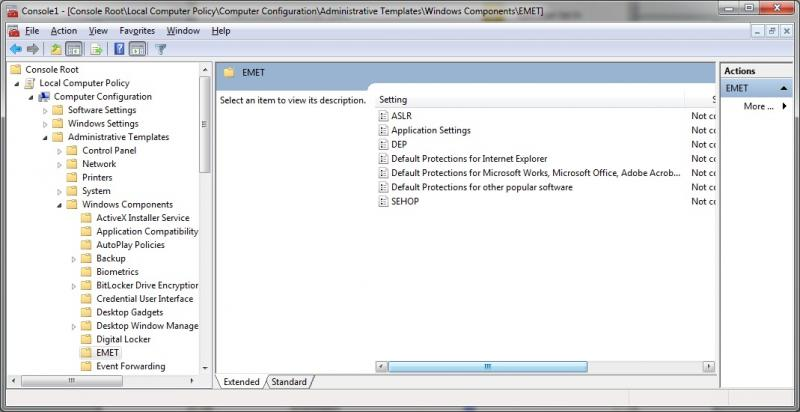
From our experiences we encountered few issues, which were easily solved by adding exceptions into our Group Policy.


Here is a list of some of the issues that we had encountered. While obviously not a comprehensive one, it will give you an idea of some of the more common pieces of software that we had seen issues with.


  • EMET with EAF battles Adobe Reader (All versions)
  • There is a known issue with EMET’s caller mitigation in Chromium since v34 (http://www.chromium.org/Home/chromium-security/chromium-and-emet).  Microsoft and the devs both say that there is no benefit to leaving EMET Caller mitigation turned on for chrome.exe.  They also recommend turning off SEHOP mitigation for chrome.
  • Msaccess.exe has to be allowed in both DEP and Caller.
  • Photoshop.exe has to be allowed in DEP.


With this tool the benefits greatly outweigh the administrative overhead. With a well thought out deployment and the Group Policy to control it. EMET is the icing on your security cake.

Thursday, May 21, 2015

Security Measures on a Budget - Part 4

Microsoft security, everyone’s favorite topic to poke fun at. For both the offense and the defense it is considered to be our job security, the bane of our existence, and sometimes an unobtainable goal. Whether we like it or not Windows Server and Desktop environments have their roots sunk deep into the infrastructure of the corporations and homes of the world. We must learn how to actively manage Windows environments without them getting away from us. How many of you can say that your home or work environment has completely removed depreciated operating systems? XP was end of life April 8th, 2014 and the extended support for Windows Server 2003 is coming up this July (https://support.microsoft.com/en-us/lifecycle/search/default.aspx). Just please do not tell me that you have anything prior than that on your network. I know there is a good chance that you do, just don’t tell me about it. It is scary enough some of the things that are out there on the internet. From old Windows 3.1 boxes, IP cameras, electrical control systems and more. HD Moore has a great talk about the scan of the internet that he performed over the whole year of 2012 and the data he collected on internet facing systems (https://youtu.be/VuYi7gVy3dI). Which includes a large amount of windows systems.
It is extremely hard to tell companies “Just patch/upgrade everything to where it needs to be”. I realize it is not just that simple. You may have business critical applications that only run on depreciated Operating Systems, the newest OS may not run on the hardware that you do not have it in the budget to replace, or maybe you just don’t have the time. Honestly most of these are just excuses in the mind of someone in information security. You are putting convenience, money, and time before protecting your critical assets. In an upcoming article I’ll cover asset and risk management is not something many do right, but it is one of the most important planning strategies that you can have.
Moving away from the obvious upgrades to current OS and software there are still many low cost or free enhancements that you can accomplish in Windows to create a more secure environment. Many can be accomplished via Group Policy (if you are in fact on an Active Directory Domain). Here are some links that I’ve always relied on and pointed others to for reference:

Best practices for GPOs (Group Policy Objects)
http://www.grouppolicy.biz/best-practices/
http://www.infoworld.com/article/2609578/security/the-10-windows-group-policy-settings-you-need-to-get-right.html
http://www.giac.org/paper/gsec/4138/group-policy-security-risks-practices/104227

Defend your Active Directory
https://youtu.be/uccM2xtE5SA - “Active Directory: Real Defense for Domain Admins”

Set local admin account passwords
http://blogs.technet.com/b/askpfeplat/archive/2014/05/19/how-to-automate-changing-the-local-administrator-password.aspx

Reduce the amount of people in Domain Admins. No one should be logging into their desktop as a domain admin. Ever. Period.

Fix everything listed here. Just do it
http://blog.spiderlabs.com/2013/09/top-five-ways-spiderlabs-got-domain-admin-on-your-internal-network.html

Implement EMET
Dave Kennedy has a great article on pushing it out domain wide. https://www.trustedsec.com/november-2014/emet-5-1-installation-guide/

Setup urlscan on IIS servers
http://www.iis.net/downloads/microsoft/urlscan

Setup bitlocker on laptops. 
This is a must if you have any chance of that laptop containing sensitive data that could be detrimental to your organization.

A few of these changes will cause growing pains as they are made, others not so much. Stronger password policies can cause the user populous to come after you with pitchforks if it’s not something that you have ever needed to change before. No cached credentials, windows firewall settings, and making changes to local system/service accounts can all create changes in process that not many people will be happy with. I’m not saying it’s easy, but these should all be a part of your overall security no matter how small or large your company happens to be.

Monday, November 10, 2014

Security Measures on a Budget - Part 3

In this article I want to cover what you and your team can do for your application security. Chances are you don’t write your own software packages, and if you do I’m not sure I can help you much! There are still plenty of measures that you can take to ensure that you’re buying a good product, the products that you currently have are secure, or ways that you can secure applications that you already possess. There are certain sets of application security rules. Some that pertain to web applications, others that pertain to writing secure code, and more that are still being worked on and directed. I’ll go over some of them here as well as some software hardening guides for applications.
OWASP otherwise known as the Open Web Application Security Project (http://owasp.org) is one of the largest collaborations of application security practices and guidelines. “Our mission is to make software security visible, so that individuals and organizations worldwide can make informed decisions about true software security risks.” They publish a great guide called the OWASP top 10. Which lists the top ten most common web vulnerabilities and how to go about combatting them. If you are looking at getting a web application or hosting one in the cloud, it’s always a good sign if the engineers on the project know about OWASP or have hardened their application to those standards. They cover such a wide area of views on this topic as well. From secure coding practices, to CISO communications and planning initiatives, to local chapter meetings, and some great literature and classes.
Another organization that is near and dear to my heart is called I Am The Cavalry (http://iamthecavalry.org). I currently volunteer for them as well. They are a somewhat newer organization and they are working on building information security frameworks into public infrastructure from the ground up. They are currently focusing mostly on the automotive industry, but are also making headway into healthcare devices, critical infrastructure, and other embedded systems. One of the practices that they would like to implement is a guide on secure software purchases. I had originally joined due to the fact that working in healthcare I would see a lot of different software packages and you realize how poorly written and configured the majority of them are. I love the passion that the organizers had and I wanted to help with their initiative.
In a less security conscious environment it would be much easier to look at the bells and whistles of what a software can do, and less on what a malicious person could do with it. This isn’t just an anomaly in healthcare software and devices, it affects every industry. When you look at a software package things like price per user, licensing fees, hardware costs, administrative overhead, and the like all usually come into play. There is so much more that should be assessed before spending a good part of your budget on a software that you might be building your company up with. Here is a good basic list to start with as a checklist for when you are working with your software vendors:
                    1.        The use of Java:
                                1.1.        Java on workstations is extremely exploitable. The less you have it in your environment the better. Vendors will sometimes not only require it, but require outdated, unsupported versions of it. This is usually a deal breaker for me.
                    2.        Firewall rules:
                                2.1.        While the local workstation/server software firewall isn’t the end-all-be-all of PC security, it does definitely help. Don’t let the software vendor tell you that you need it turned off.
                                2.2.        Small exceptions are fine. Find out what port or .exe needs allowed through.
                    3.        Anti-virus:
                                3.1.        Lots of people in the infosec industry say that anti-virus is dead. There are so many malware and rookits out in the wild that it doesn’t matter. But I believe it does.
                                3.2.        Security is a process, and processes have lots of moving parts. A/V should not only be installed on all of your endpoints, but it should be running scheduled and live scans as well.
                    4.        Windows Updates:
                                4.1.        Make sure you know who’s responsibility it is to keep the workstations/servers/appliances up to date. It’s very painful if the software company has a difficult approval process for updates.


            Whatever software you have implemented in your organization, chances are there is a good hardening guide out there for it. Particularly vulnerable applications include Wordpress, IIS, Apache, & Exchange (as well as every other mail server platform). If you have any specific questions feel free to reach out to me on twitter @infosystir.

Saturday, November 8, 2014

Security Measures on a Budget - Part 2

    In my last article I covered some places that you can find good best practice guides as well as some of the organizations that provide these guides. In this second part of Security on a Budget I’ll go over some good networking practices that you may not currently be doing. I can not stress how important best practices are, especially in security. These security holes are some of the first things that criminal attackers will look for, and what will show up as high risk on a vulnerability assessment. Unfortunately they are also common practice on many types and sizes of networks. There always comes a point when a business has to take calculated risks. But sometimes you don’t even have a way of calculating the risks because of so many unknowns. Rest assured all best practices mentioned here should be adhered to.
    The first thing I’ll go over is network segmentation. Having a broad flat network without any physical firewall separation is a bad practice, and fixing it is relatively cheap to accomplish. Not only should you put firewalls in place between your internet facing devices/servers (DMZ), but also between key portions of your network, can create a good security posture if implemented correctly. One of the best ways to implement a firewall in an already existing environment is to put the firewall inline so it can see all the traffic, and then start creating restrictive rules. The least privilege is always a best practice. This step allows only the devices that are authorized to pass network traffic to certain points. Along with the addition of firewalls one can segment with vlans as well. Vlan1, the default vlan,  should not be a production vlan. Different types of devices can also be segmented off into their own vlans with access lists between them. While access lists are very helpful and also free, they should be used in addition to the firewalls.
    Something that is free and very easy to accomplish, is turning on port security as well as disabling switch ports that are not in use. Port security, when enabled, will automatically disable a switch port if one device is unplugged and replaced with another. These both prevent malicious people or potentially infected devices from being plugged into your network without the proper security scanning and vetting. It is a good security measure to perform virus and vulnerability scans on equipment before it is attached to your network. I have seen on multiple occasions, computers or equipment ship from a vendor already infected with malware and viruses. A tool that can help out with streamlining changes such as this is Rancid. Rancid (http://www.shrubbery.net/rancid/)  can not only save backups of your switch and router configuration, but it can also push changes such as this to cut down on time spent logging into each device and manually typing out commands. Automation tools like this can be extremely powerful and should be used on a test environment if you are unsure of the effects.
    Another piece of free software is Netdisco (http://www.netdisco.org). You can download it as a virtual machine and there is little setup needed to get it up and working in your environment. It is a network reporting tool that will keep track of all MAC addresses, IP addresses, Vlans, manufacturers, and the like on your local area network. It is all web based and very easy to use and gather reports from. It will also let you know what versions of firmware are on your switching and routing infrastructure. Speaking of firmware, updating the firmware on all infrastructure devices is also best practice. As well as changing default snmp community strings, setting your idle timeouts, and creating complex passwords. An authentication manager such as TACACS+ can provide you with centralized authentication if your hardware supports it.

Security Measures on a Budget - Part 1

Talk to a security vendor and they’ll try to sell you the moon to secure your network, data, email, and everything else. But what are you already doing to strengthen your security posture without breaking your budget? I believe that it’s always best to try the free tools and resources first. Not only will it give you experience and insight into what is out there, but you may also find one of the many great solutions out there. This four part series of articles will go over what you can do with free or budget friendly items to get as far as you can on a mission to a better security posture. First we’ll focus on reasons why and some good places to find information as well as good starting points for finding best practice guides, next network security, then on application security, and finally on windows security.

“Many attacks on Internet and network systems have no particular target. The attacker simply sends a large broadcast that uses any unprotected system as a staging point from which to launch an attack. Using computers without basic protections like firewalls, anti- virus software, and user education not only affects your own business, but many other businesses as the virus is spread around the Internet.
Your system’s lack of protection makes you a target: it can destroy your computer, your network, and can contribute to a virus distribution that slows or halts portions of the Internet. All of us who use the Internet have a responsibility to help create a culture of security that will enhance consumer and business confidence. But most importantly, failing to heed best practice advice could hurt your company significantly” -  Internet Security Alliance Guide1

The ISA is a great resource for articles and publications on information security best practices. Attackers will always be attempting to get in.

Whether it’s a targeted attack, or your network just falls in the mix with a larger list around the world. Best practices across your infrastructure go a long way in preventing the broad automated attacks. Here are a couple daily reads good for any size business:
1. http://isc.sans.edu - The Internet Storm Center was created in 2001 following the successful detection, analysis, and widespread warning of the Li0n worm. Today, the ISC provides a free analysis and warning service to thousands of Internet users and organizations, and is actively working with Internet Service Providers to fight back against the most malicious attackers.2
2. http://dashboard.csoonline.com - This dashboard combines some of the more important feeds from around the internet combined all into one easy to read format. It includes some industry specific feeds as well as provides a good quick overview on daily security happenings.


1. http://bit.ly/UbyO2q
2. https://isc.sans.edu/about.html

Vulnerability Assessments and Penetration Tests: The differences and why you need both

It’s 2014. There is so much data out there. How much are you responsible for? If you own data and it rests under your control you are at risk, it’s as simple as that. What are you actively doing to mitigate those risks or report on them? Two very important additions to any security planning would be Vulnerability Assessments and Penetration Tests. While both can teach you a lot about the weak spots in your infrastructure they are both equally different and important.
A Vulnerability Assessment (VA) will show you all of the places on your network that are susceptible to attack due to improper configuration, missing patches, or unsupported software. You should expect to end up with a list of vulnerabilities listed from most to least critical. This list will help you prioritize items that need remediated in your network and applications. Common findings include missing windows or adobe/java patches, insecure passwords, improper IIS/apache or SQL configurations. The report may also include recommendations on network changes including restructuring and segmentation.
 Many different organizations are required to have VAs from Approved Scanning Vendors (ASV’s) to be considered compliant. PCI DSS, HIPAA, & SOX are some of the standards that require compliance, depending on your business model you may fall under one or more. With a little work, running your own VA scans are something that should be done. While running them yourself doesn’t qualify towards compliance, it is still a good idea to perform tests between ASV’s coming out on site. Some of the most popular scanning packages are Nexpose, Nessus, Qualys, and Burp Suite. With a little research and the approval from your organization you can go a long way with preventative steps between VAs.
A Penetration test (pentest) is a simulation of an internal or external (or both) attack on your network. There is usually a goal in mind, like accessing a company database, modifying or capturing files, or accessing key infrastructure. The deliverable for this test would be a report of how your system was breached, what was able to be accessed, and what can be done to remediate. If something shows up on a Vulnerability Assessment, it can be used by an attacker in some fashion. One other thing that can be leveraged during a pentest is probably one of the weakest elements in your organization, the human element. Things such as phishing (fake emails) , pretexting (fake calls) , tailgating (following people into secure areas), and the like can be used to gain access to areas or systems that don’t even have a technical vulnerability. 
You can consider a Penetration Test like a fire drill compared to the Vulnerability Assessment which is more of a building inspection. While both are giving you a better look into the security of your network they are equally different and important. If you haven't yet, I highly suggest contacting an information security company and scheduling one.